
Any product sold as a real magic pill for fat loss has to pass one simple test. It has to change the balance between the energy you take in and the energy you use, by enough to matter. This piece runs that test: first the energy rule as the NHS puts it, then what the trials found when pills were measured, and then where the calories in an ordinary day, including a portion of dates, actually come from.
The rule every pill is up against
The NHS page on understanding calories is short and plain. To stay at around the same weight, the calories your body uses should be the same as the calories you eat and drink. You're likely to lose weight if you eat and drink fewer calories than you use, because your body then uses its stored fat for energy.
As a guide, the same page says an average man needs 2,500kcal a day and an average woman needs 2,000kcal. It adds that this could be different based on your age, weight, height and how much exercise you do. The NHS tips page sets the pace: aim to lose 1 to 2lbs, or 0.5 to 1kg, a week, and do not lose weight suddenly with diets.
What happened when pills were measured
A 2021 systematic review led by Batsis (PubMed 34159755) started from 20,504 citations and found 315 randomised controlled trials of dietary supplements and alternative therapies for weight loss in adults. Only 52 were classed as low risk of bias and sufficient to support efficacy. Of those, 16 showed significant differences in weight between groups, ranging from 0.3 to 4.93kg. The authors wrote that these products are sold as a panacea for weight gain as a result of the minimal regulatory requirements for demonstrating efficacy.
A 2020 review led by Maunder at the University of Sydney (PubMed 31984610) reviewed 54 placebo-controlled trials of herbal medicines in overweight or obese adults, and treated a difference of 2.5kg or more as clinically significant. Its conclusion: there is currently insufficient evidence to recommend any of the herbal medicines it included for weight loss.
Neither review found the evidence to rely on a pill. The energy rule still holds, and the place to apply it is what goes on the plate and into the cup.
Where the calories in a day come from
The NHS eight tips page points to a few places worth checking. Keep an eye on the fats added during cooking or serving, it says, because that is what increases the calorie content: oil on chips, butter on bread, creamy sauces on pasta. Gram for gram, the carbohydrate in starchy foods provides fewer than half the calories of fat.
Drinks are next. The page suggests avoiding sugary soft and fizzy drinks, as they're high in calories, and notes that even unsweetened fruit juice and smoothies are high in free sugar. The tips page has the matching swap: sugary drinks for water, with lemon or lime slices if you don't like the taste.
Another check is on the packet. The calories page says calorie information on nutrition labels is displayed under the "energy" heading, and suggests planning meals to help you manage your intake.
Counting a portion of dates
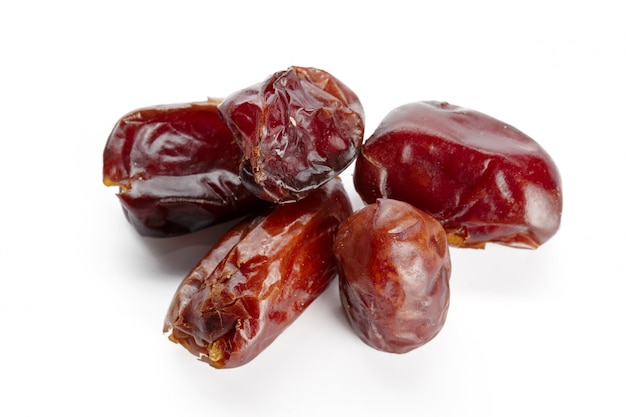
Dates have a label too. USDA FoodData Central (SR Legacy, 2019) gives Medjool dates 277 kcal per 100g (FDC 168191) and Deglet Noor 282 kcal (FDC 171726). The NHS counts a 30g portion of dried fruit, and it names dates, as one of your 5 A Day. At 30g, Medjool comes to about 83 kcal and Deglet Noor to about 85 kcal.
Against the NHS guide figure of 2,000kcal for an average woman, that portion is a little over 4% of the day. Weighing the 30g is what makes that figure hold. The NHS also says dried fruit should be eaten at mealtimes, not as a snack between meals, to reduce the impact on teeth. Chopped into breakfast cereal or served after dinner, the portion stays part of a planned meal.
The same records also give fibre: 6.7g per 100g for Medjool and 8.0g for Deglet Noor. Medjool is the large, very soft date with a rich caramel taste. Deglet Noor is golden and semi-dry, from Tunisia and Algeria.
The parts of the plan with no pill in them
The NHS tips page lists the rest. Get active for 150 minutes a week, which you can break into shorter sessions. Read food labels, where more green colour coding than amber and red often means a healthier option. Do not skip meals, because you might end up snacking more when you feel hungry. Share your plan with someone you trust, who can help on a bad day. If you're worried about your weight, the eight tips page says to ask your GP or a dietitian for advice.
Buying dates in Malaysia
Every date sold in Malaysia is imported, as the country has no commercial date-growing trade. Pembekal Kurma Selangor is another date supplier site to compare. The Iran Date Fruit about us page mentions delivery across the country, and the contact page has a WhatsApp number for questions or orders. More reading is on the Iran Date Fruit blog.
This article is general information about food and is not medical advice.