
Lists of weight loss foods are easy to write and hard to check. This one sticks to foods that someone actually put to the test, with real people, a control group and a number at the end. Five foods made it. Each result is smaller than the word "potent" suggests, and each comes with a condition worth knowing.
1. Beans, lentils and chickpeas
Pulses are the dry seeds of legumes: beans, lentils, chickpeas and dry peas. A 2016 meta-analysis in the American Journal of Clinical Nutrition (PubMed 27030531) pooled 21 randomised trials with 940 participants. Diets that included pulses, at a median of 132g a day or about one serving, produced 0.34kg more weight loss than diets without them, over a median of six weeks.
That is a third of a kilo. The authors called it "a modest weight-loss effect", and it showed up even when the diets were not meant to cut calories. A bowl of dhal or a chickpea curry is one way to reach about one serving a day. On the NHS 5 A Day page, 80g of pulses and beans counts as a portion, but pulses only count once towards your 5 A Day.
2. Eggs at breakfast, with a calorie cut
A trial led from Saint Louis University (PubMed 18679412) gave 152 overweight or obese adults aged 25 to 60 either a two-egg breakfast of 340 kcal or a bagel breakfast matched for calories and energy density, on at least five days a week. One egg group and one bagel group were also advised to follow a low-fat diet with a 1,000 kcal energy deficit, while the other two were asked not to change how much they ate.
After eight weeks, the egg-plus-diet group had lost 2.63kg against 1.59kg for the bagel-plus-diet group. Without the diet, eggs made no significant difference. So the egg breakfast helped a calorie cut work a little better. On its own, it did nothing measurable.
3. A whole apple before lunch
At Penn State, 58 adults ate apple in different forms 15 minutes before a lunch where they could eat as much as they liked (PubMed 19110020). Each form came at the same weight and calories, 266g and 125 kcal: a whole apple, applesauce, or apple juice with or without added fibre.
The whole apple cut total lunch energy, apple included, by 15%, or 187 kcal, compared with having nothing first. It also beat the applesauce and both juices. Adding fibre to the juice did not make it any more filling.
That result matters for dates too. The NHS limits fruit juice, vegetable juice and smoothies to a combined 150ml a day, and it says crushing fruit and vegetables into juice and smoothies releases the sugars they contain, which can damage teeth. Dates eaten whole are a different case from date drinks or blended date shakes.
4. Vegetable soup to start
A second Penn State study (PubMed 17574705) brought 60 normal-weight men and women to the laboratory for lunch once a week for five weeks. Before lunch they had one of four vegetable soups, from broth with the vegetables on the side to fully pureed, or no soup at all, and then ate as much of a test meal as they liked.
With soup, people ate 20% less over the whole meal, or 134 kcal. The form of the soup made no significant difference. Chunky or smooth, a low-energy-dense soup first did the same job.
5. A large, lightly dressed salad
Rolls, an author on both of those studies, also tested salad on 42 women (PubMed 15389416). Each week for seven weeks they ate a compulsory first-course salad, or none, followed by as much pasta as they wanted. The salads came in two sizes, 150g or 300g, and three energy densities, 0.33, 0.67 or 1.33 kcal per gram, set by changing the amount and type of dressing and cheese.
The low-energy salads cut total lunch intake by 7% for the small bowl and 12% for the large one. The rich salads did the opposite, raising intake by 8% and 17%. The dressing and cheese decided which way the salad went.
What the five have in common
Three of the five results came from single test lunches. They show people eating less at that meal, not losing weight over months. The two longer studies, on pulses and eggs, found real but small differences, under half a kilo for pulses over about six weeks and about a kilo extra for eggs over eight weeks with a diet.
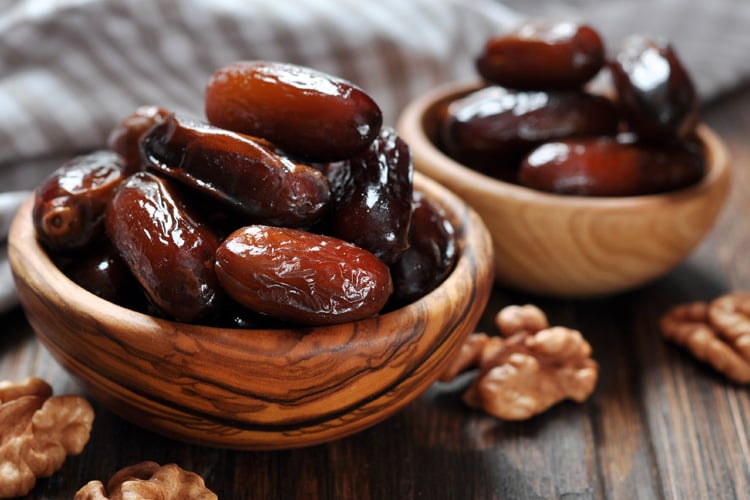
The apple, soup and salad trials share one idea: a filling food with few calories per gram, eaten first. The apple in that study worked out at 0.47 kcal per gram. USDA FoodData Central lists Medjool dates at 277 kcal per 100g, which is 2.77 kcal per gram, about six times as much.
That does not rule dates out. It changes how to use them. The NHS counts a 30g portion of dried fruit, and it names dates, as one of your 5 A Day, to be eaten at mealtimes rather than as a snack between meals, to reduce the impact on teeth. For Medjool, 30g is about 83 kcal. Put that portion with a meal that starts with soup or salad, and the sweet part comes at the end, in a measured amount.
Ordering dates
Iran Date Fruit supplies dates to consumers, retailers and traders across Malaysia and offers fast delivery nationwide, according to its about us page. Questions and orders go through WhatsApp on the contact page. You can find more reading on dates on the Iran Date Fruit blog.
The older version of this post linked to https://KurmaHarga.com, and that link stays here for anyone who used it.
This article is general information, not personal advice. If you are planning a big change to how you eat, talk to your GP or a dietitian first.