
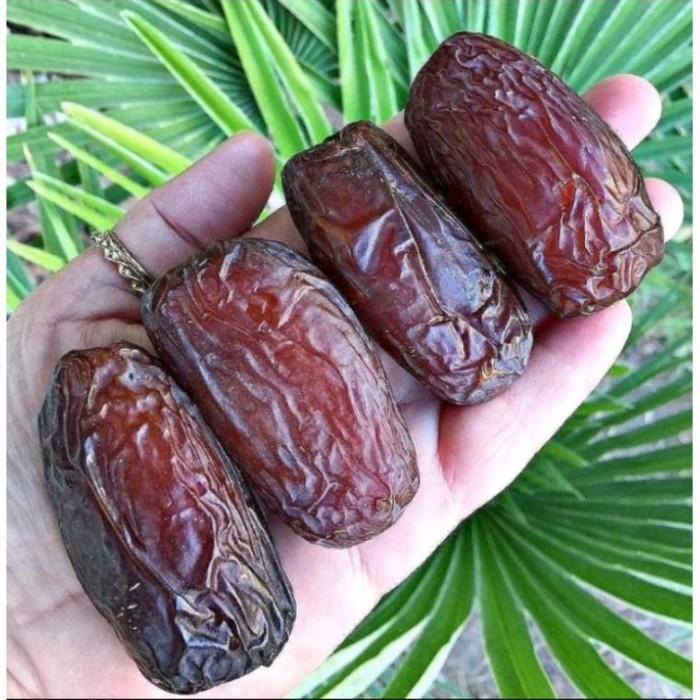
Medjool from Palestine vs. the dates grown in Iran
Palestine is one of a handful of regions that grow Medjool at real scale, alongside Jordan and, more recently, parts of the Gulf. Iran doesn't grow Medjool commercially in any real volume — its date-growing regions (Kerman, Sistan-Baluchestan, Bushehr) are built around different cultivars: Mazafati, Piarom, Zahedi, Kabkab. So when a Medjool date from Palestine turns up next to a tray of Mazafati or Piarom, the comparison is really between two different plants, not two grades of the same fruit.
Taste and texture side by side
Medjool is large, meaty, and caramel-sweet — the flesh is thick enough that a single date feels like a proper snack rather than a bite. Medjool dates from Palestine in particular are prized for a flavor that leans toward toffee rather than straight sugar. Iranian Mazafati, by contrast, is smaller, darker, and much moister — almost jam-like in texture, with a flavor that's less caramel and more raisin-forward. Piarom sits at the other extreme: dry, chewy, semi-translucent, and intensely sweet, closer to a dried fig in mouthfeel than to a fresh Medjool.
Why the difference comes down to ripening, not just variety
Every date passes through the same four ripeness stages — kimri, khalal, rutab, tamr — but different cultivars are harvested and sold at different points in that cycle. Medjool is almost always sold at rutab-to-tamr, which is why it stays soft. Piarom is deliberately taken further into tamr and semi-dried, which is why it ends up chewier. Mazafati is picked and sold close to rutab, which is why it's moist enough to need refrigeration to avoid fermenting.
What this means if you're choosing between them
Buyers comparing Palestine Medjool to Iranian varieties are really choosing a texture profile more than a "better or worse" product: soft and meaty (Medjool), moist and jammy (Mazafati), or dry and intensely sweet (Piarom). Storage needs differ too — Mazafati needs the coldest, most consistent storage of the three, while Medjool and Piarom hold up better at room temperature for short periods.
Conclusion
Medjool dates from Palestine and Iran's own date varieties aren't really competing on the same axis — they're different fruit, ripened and sold at different stages, suited to different uses. Knowing the difference in taste and texture makes it easier to pick the right one for the occasion, rather than assuming one is simply a substitute for the other.
Key highlights
- Palestine grows Medjool commercially; Iran's main cultivars (Mazafati, Piarom, Zahedi, Kabkab) are different varieties entirely.
- Medjool is large and caramel-sweet; Mazafati is moist and jammy; Piarom is dry, chewy, and intensely sweet.
- The texture difference comes largely from which ripeness stage each variety is harvested and sold at.
- Choosing between them comes down to texture and storage needs, not one being a straight substitute for another.